
In light of the current review of the EU Drone Strategy 2.0, AME has once more joined forces with other industry associations to convey a streamlined message to the European Commission.
Seven years after the introduction of the EU drone regulation and three years after the adoption of the EU Drone Strategy 2.0, there is a gap between the strategic ambition, regulation and actual market deployment. While progress has been made on some points, drone operations remain extremely limited in the EU. At the same time, resources are scarce, and time is running out.
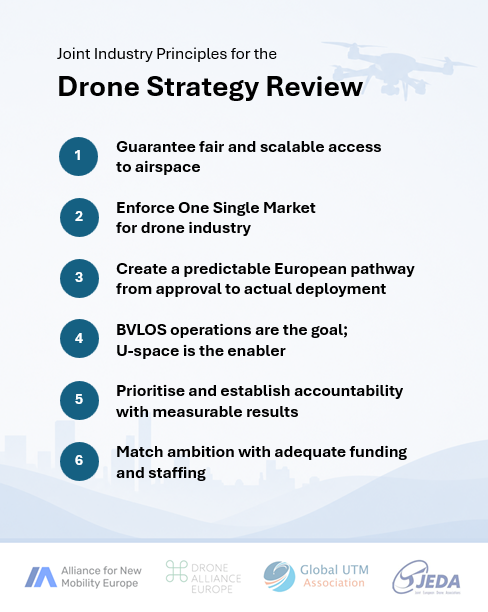
This is why Europe needs to focus on the structural problems and key enablers:
- Guarantee fair and scalable access to airspace
Treat European airspace as a shared economic resource and establish a BVLOS airspace-integration package with concrete actions and deadlines for electronic conspicuity, SERA reform and common DAA validation. - Enforce One Single Market for drone industry
Make operational approvals and USSP certification portable across the Single Market and eliminate Market-breaking conditions such as unjustified national reassessment, cross-border duplication and geographical zone fragmentation. - Create a predictable European pathway from approval to actual deployment
Establish a coordinated European framework that enables the transition from aviation authorisation to real-world deployment, including common principles for local implementation and structured coordination between aviation, security and defence authorities. Local and security-related requirements should remain proportionate, objective and predictable, while security and defence capabilities should, where appropriate, be interoperable with civil infrastructure to also support civil airspace integration. - BVLOS operations are the goal; U-space is the enabler
Set a European target of 5 million routine commercial BVLOS flights per day by 2030 and deploy U-space where operational demand requires it. - Prioritise and establish accountability with measurable results
Turn Drone Strategy 2.0 into a prioritised delivery programme with named owners, deadlines, milestones and transparent progress tracking. - Match ambition with adequate funding and staffing
Provide substantial and coherent funding from research to validation to operational deployment that aligns with these strategic priorities.
EASA and national aviation authorities must be adequately resourced to enable timely, scalable implementation while leveraging mechanisms that can streamline certification and oversight.
Europe must maximize civil-security-defence synergies, ensuring relevant investments and airspace-monitoring capabilities support safe, scalable BVLOS operations.